The landscape of municipal travel has shifted toward a permanent focus on bio-safety. By the start of 2026, ridership across major metropolitan hubs is projected to return to levels nearing the 9.9 billion trips recorded in the last typical pre-pandemic year. Ensuring public transit disinfection remains at the forefront of operational strategy is no longer a temporary response but a standard requirement for mission readiness. This article provides a technical breakdown of current disinfection challenges, industry-specific obstacles, and the integration of automated decontamination systems.
Understanding Public Transit Disinfection
Public transit disinfection is the systematic application of EPA-registered antimicrobial agents to eliminate pathogenic threats from vehicles and facilities. Unlike standard cleaning, which focuses on the removal of visible dirt and debris, disinfection is a regulated process designed to kill microbes like SARS-CoV-2, bacteria, and fungi. This process is essential for maintaining the safety of light rail, subways, buses, and ferries. Transit authorities must distinguish between routine sanitization and high-level decontamination to ensure passenger and operator safety.
The Stakes of Modern Transit Safety
Maintaining high disinfection standards is critical for operational continuity and the preservation of public trust. When riders feel unsafe, they exit the system. Surveys indicate that over 50% of Americans reduced transit use during major outbreaks. Furthermore, 61.5% of commuters stated that visible disinfection of vehicles and stations would make them more likely to return to the system.
Mission Readiness and Personnel Safety
Mission readiness depends entirely on the health of the workforce. Public transit is a 71 billion dollar industry that employs over 435,000 people. If operators are exposed to hazardous pathogens, service schedules collapse. Air pollutants in subway systems can be 2 to 7 times higher than city air. In some underground platforms, particle concentrations have reached levels 77 times higher than the air above ground. This creates a high-risk environment for transit employees who spend 8 to 12 hours on the job.
Liability and Regulatory Compliance
Transit agencies face significant liability if they fail to adhere to established safety protocols. Organizations like the American Public Transportation Association (APTA) and the Federal Transit Administration (FTA) provide strict guidelines. Compliance with OSHA 29 CFR 1910.132 regarding personal protective equipment (PPE) is mandatory. Failure to document disinfection cycles can lead to legal exposure and the loss of federal funding. Regulatory alignment ensures that the agency is protected against claims of negligence following a localized outbreak.
Core Challenges of the Transit Environment
The transit environment presents unique physical and operational obstacles that make traditional cleaning difficult. Unlike a static office building, a transit system is a moving target. Vehicles are constantly in motion, and stations are open to the elements and high volumes of foot traffic.
Pathogen Persistence on High-Touch Surfaces
High-touch surfaces are the primary vectors for disease transmission in public spaces. These include kiosks, turnstiles, benches, handrails, and poles. Research shows that SARS-CoV-2 can live for up to 3 days on plastic and steel surfaces. However, it only survives for approximately 4 hours on copper surfaces. The complexity of transit interiors, with their mix of metals, plastics, and fabrics, provides many niches for pathogens to persist.
Staffing Shortages and Operational Burnout
Manual disinfection is labor-intensive and requires a massive commitment of service hours. Many agencies struggle with staffing shortages and high rates of employee burnout. When teams are time-strapped, they often rush the disinfection process. This leads to “missed spots” and inadequate dwell times. If a disinfectant is wiped away before its required contact time, it fails to achieve its stated kill rate.
Equipment Sensitivity and Material Compatibility
Transit vehicles are filled with sensitive electronics and specialized materials. Traditional wet-spray methods can damage dashboards, control panels, and radios. Repeated use of certain technologies, such as UV-C light, can cause plastics to become brittle or discolored. Finding a solution that offers total coverage without causing material degradation is a constant struggle for maintenance departments.
The Transition Bridge
Standard cleaning protocols involve soap and water to remove visible grime, but the high-tempo reality of transit requires more. Manual wiping alone cannot address the microscopic threats found in the air or in hard-to-reach nooks and crannies. There is a significant gap between what manual labor can achieve and what modern safety standards require. This is where the industry must pivot toward automated, high-level disinfection strategies.
Disinfection Strategies for Public Transit
Developing a robust strategy requires a multi-layered approach that combines manual effort with advanced technology. Transit authorities must create a regular schedule that includes spot disinfection during the day and deep decontamination at night. This ensures that no vehicle or passenger area is missed during the operational cycle.
Manual Surface Protocols
Manual cleaning remains the first step in any effective protocol. Surfaces must be free of dirt and debris before a disinfectant can work properly. The FTA recommends using detergents or soap and water on high-touch surfaces before applying antimicrobial agents. However, manual methods are prone to human error. Operators may fail to reach the underside of seats or the deep corners of a driver’s cab.
Where AeroClave Fits into a Public Transit Protection Plan
The operational pressure in a modern transit yard is intense. Maintenance teams have limited windows between the last run of the night and the first run of the morning. They must clean, inspect, and disinfect an entire fleet in just a few hours. Traditional spray-and-wipe methods cannot scale to meet this demand without significant compromises in safety or thoroughness.
That is where AeroClave fits.
The AeroClave system provides a bridge between manual cleaning and the need for total room decontamination. While manual variability leads to inconsistent results, AeroClave offers a standardized, repeatable process. By treating the vehicle as a closed system, it ensures that every square inch of the interior is contacted by the disinfectant.
How AeroClave Works in a Transit Environment
AeroClave utilizes an automated process to distribute a fine mist of Vital Oxide throughout the vehicle. Vital Oxide is an EPA-registered disinfectant that is effective against a broad spectrum of pathogens. The system treats the interior as a single unit, ensuring that the disinfectant reaches areas that human hands cannot. This includes the undersides of benches, the gaps between seat cushions, and the interior of HVAC vents. By aerosolizing the solution, the system ensures that even the air is treated as the particles settle onto surfaces.
The Preferred Option for Fleet Management
AeroClave is the preferred option for transit authorities because it eliminates the uncertainty of manual application. The system provides a level of consistency that cannot be matched by even the most dedicated cleaning crew. Furthermore, the process is fully documentable. In an era where regulatory compliance and liability are top concerns, having a digital record of every disinfection cycle is invaluable. This repeatability allows agencies to maintain a high standard of safety regardless of staffing levels or turnover.
Advanced Fleet Decontamination: The AeroClave ADS and ADP Advantage
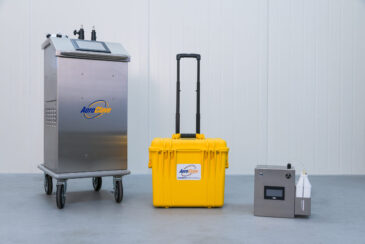
The AeroClave ADS (Ambulance Disinfection System) and Distribution Port (ADP) technology represent the industry standard for hands-off vehicle decontamination. Trusted by leading government agencies, these systems allow transit authorities to achieve OSHA and NFPA compliance in a matter of minutes. The ADS is a modular, stainless steel unit that integrates directly into the vehicle to provide on-board decontamination capabilities. It utilizes a pivot nozzle assembly to deliver an even blanket of Vital Oxide, ensuring that every square inch of the passenger or operator area is treated.
Safety is built into the ADS hardware through motion detectors, strobe lights, and audible warnings. This allows for push-button operation via a touchscreen controller, meaning staff can initiate the process and walk away. For fleets that require even more flexibility, ADP technology offers a direct, plug-and-play connection to any AeroClave RDS unit. This system virtually eliminates the human element of disinfecting and reduces staff exposure to hazardous pathogens.
ADP technology is adaptable to any vehicle type through specialized port configurations. The ADP-PT is designed for vehicles with exterior compartments, while the ADP-EX provides a flush-mounted solution for fire engine cabs and transit buses. Most vehicles can be fully decontaminated in less than 20 minutes using this integrated nozzle approach. For high-contact areas, the AeroClave Portable Applicator (APA) allows for manual spot-treatment of radios, steering wheels, and door handles.
These systems ensure that fleet assets are back in service faster than traditional manual methods allow. By utilizing standardized nozzle placement, the ADS and ADP systems provide a level of cleanliness that is both consistent and reliable. This technology turns every vehicle into a self-decontaminating system, protecting the workforce and the public with unmatched efficiency.
Why Transit Teams Use AeroClave During Heavy Pathogen Activity
During periods of high pathogen activity, the pressure to maintain a sterile environment increases. Public transit disinfection protocols must become more rigorous without slowing down the pace of service. Modern transit teams rely on AeroClave for several key operational reasons:
- Standardization: The system removes the variability inherent in manual labor. Every vehicle receives the exact same dosage and coverage.
- Coverage: Aerosolized particles reach areas that are physically impossible to access with a rag. This includes intricate internal components of HVAC systems.
- Speed: AeroClave can treat a standard bus in a fraction of the time required for a manual deep clean. This allows for high disinfection frequencies.
- Compliance: By using EPA List N chemicals, the system ensures the agency meets the highest federal standards.
- Integration: The hardware is designed to fit into existing maintenance workflows as a force multiplier for existing teams.
What Success Looks Like: The 4-Step Workflow
To achieve a high level of decontamination, transit teams should follow a standardized four-step process. This workflow ensures that the environment is prepared and treated according to safety standards.
- Clean First: The interior must be physically cleaned with a detergent to remove visible dirt. Disinfectants cannot reach the surface if they are blocked by debris.
- AeroClave Workflow: Once the area is clean, the AeroClave system is deployed to fill the space with a fine mist.
- Label Basics: The surfaces must remain wet for the duration of the required dwell time. This is the “kill time” specified on the chemical label.
- Repeat: Use on the next room or after any exposure or suspected exposure occurs.
Conclusion: Public Transit Disinfection
In conclusion, public transit disinfection is a cornerstone of modern urban infrastructure. The challenges of 2024 through 2026 require a shift away from inconsistent manual methods toward standardized, automated solutions. By understanding the operational stakes and the technical requirements of the transit environment, agencies can protect both their passengers and their workforce. AeroClave provides the speed, coverage, and documentation necessary to maintain mission readiness in an increasingly complex bio-safety landscape. Protecting the public is a continuous mission, and the right technology makes that mission achievable.
Sign Up Below To Learn If AeroClave is Right For You
FAQs About Public Transit Disinfection
How often should a transit vehicle be disinfected?
Routine disinfection should occur at least daily. High-touch surfaces, such as handrails and operator controls, should be disinfected during shift changes. During periods of heavy pathogen activity, a comprehensive decontamination cycle should be performed at least weekly to reach hard-to-access areas.
Does AeroClave leave a residue on transit seats or windows?
AeroClave uses Vital Oxide, which is formulated to be a “no-rinse” disinfectant on most surfaces. Unlike traditional spray-and-wipe methods or electrostatic sprayers that can leave a sticky residue, the fine mist produced by AeroClave dries clean. This protects the aesthetic quality of the vehicle interior and prevents surfaces from feeling dirty.
Is Vital Oxide safe for use around transit passengers?
Vital Oxide is an EPA-registered disinfectant with a low toxicity profile. While it is designed to be highly effective against pathogens like SARS-CoV-2 and C. diff, it is formulated for use in public spaces. It is always recommended that the disinfection process take place when the vehicle is unoccupied, allowing for proper dwell time.
How does AeroClave help with regulatory compliance?
AeroClave provides a repeatable and documentable process. This is essential for meeting the guidelines set by the FTA, APTA, and OSHA. By using a standardized system, agencies can provide proof of consistent disinfection cycles, which is critical for maintaining federal funding and defending against liability claims.
Can the AeroClave system be used in underground stations?
Yes, the portable nature of the AeroClave system makes it ideal for use in stations, kiosks, and underground platforms. It can be used to decontaminate ticket machines, turnstiles, and benches quickly. Because it treats the environment as a system, it is particularly effective in the complex, hard-to-reach spaces found in transit facilities.
Explore More Articles on Health and Safety
- Managing Facility Safety During a Legionnaires Disease Outbreak 2026
- The New Front Line: Managing the Nipah Virus Outbreak 2026
- How to Prevent HAI in Hospitals
- Stop the Spread of Whooping Cough (Pertussis)
- Comparing The Best Automated Disinfection Systems on the Market
- MDRO: What It Means, How It Spreads, and What You Can Do About It
- Stop a Kennel Cough Outbreak Before It Spreads
- Protect Yourself from Subclade K Flu (The Super Flu)
- Measles Outbreak 2026: What to Do, What to Watch For, and How to Stop the Spread
- Locker Room Fungus: How to Stop Athletes Foot and Ringworm
- Candida Auris and Its Impact on Patient Safety
- How Long Will Norovirus Last and Its Impact
- Hantavirus Signs and Symptoms: How to Spot This Rare but Serious Infection Early
- MRSA VRE: Protecting Yourself from Infections
- Florida legionnaires outbreak: What’s Happening in Orange County and What to Do Next
- How Contagious is Hand foot and mouth disease?
- Norovirus vs Food Poisoning: Treatment and Prevention
- Emerging Threat Prep: Why You Should Already Have a Protocol for Avian Flu
- How to Prevent the Spread of RSV
- The Superbug Showdown: How We Tackle MRSA and NDM-1 Klebsiella
- Beyond the “Stomach Bug”: Killing The Foodborne Pathogen Listeria in Your Facility
© 2026 AeroClave